Following our foundational setup and operational overview of pneumatic plastic staple technology, manufacturing facilities frequently face a critical next-step challenge: How do you optimize this equipment for diverse product geometries while minimizing blade wear costs? Industrial packaging lines handling everything from heavy hardware tools to delicate silicone kitchenware require more than just standard fastening. They demand adjustable precision and robust material compliance. This article dives deep into the technical specifications, unique blade-free cutting technologies, and multi-sector applications of high-performance Dual-Head Pneumatic Bundling Machines.
1. Technical Specifications: The Industrial Benchmark
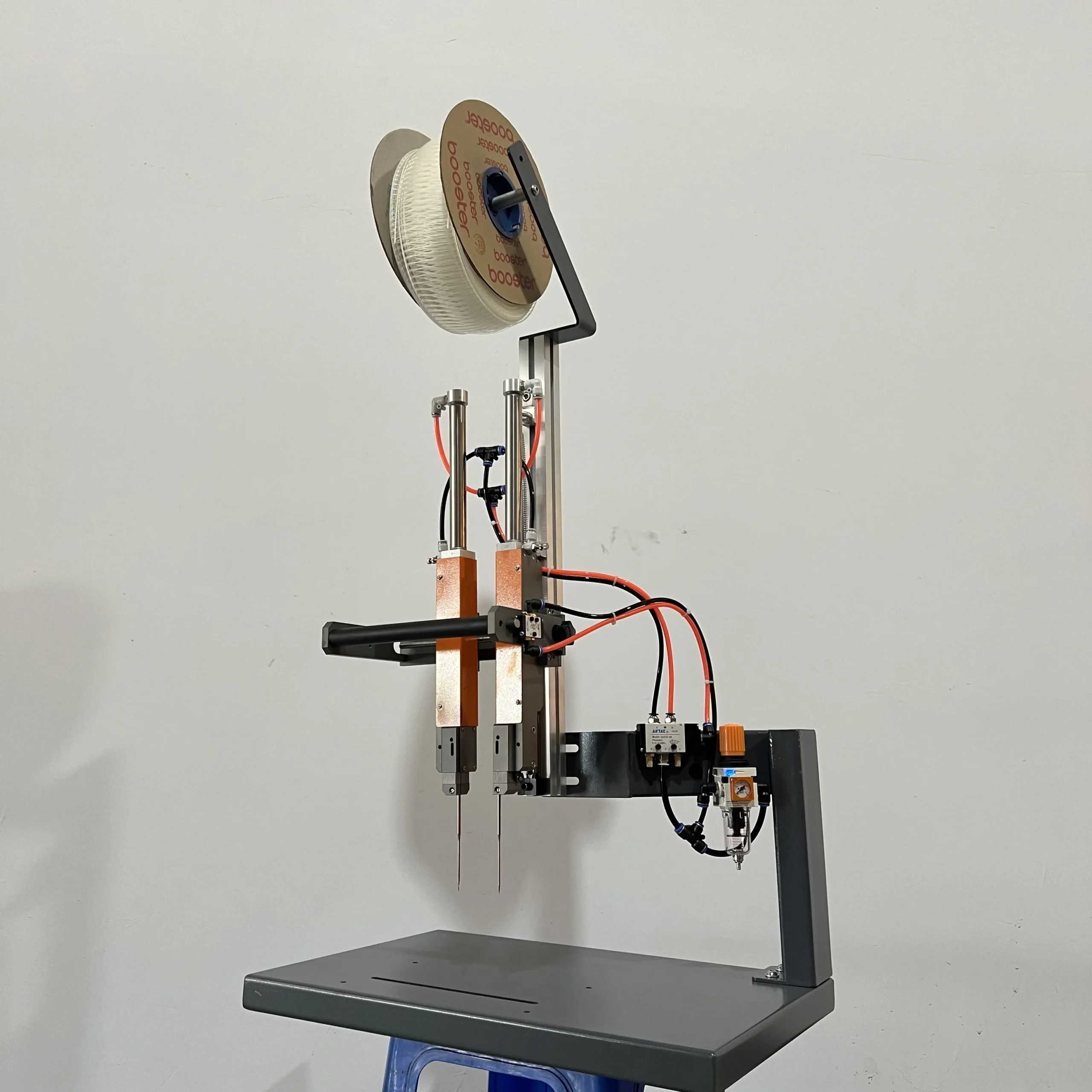
To integrate a pneumatic elastic stapling system seamlessly into a high-speed assembly line, engineering teams must evaluate its physical and mechanical limits. Below are the standard technical benchmarks for heavy-duty desktop pneumatic bundling units:
Actuation & Drive System: Dual-Cylinder Pneumatic Drive (100% Air-Powered)
Operating Pressure Range: 0.4 to 0.5 MPa (4 to 5 bar)
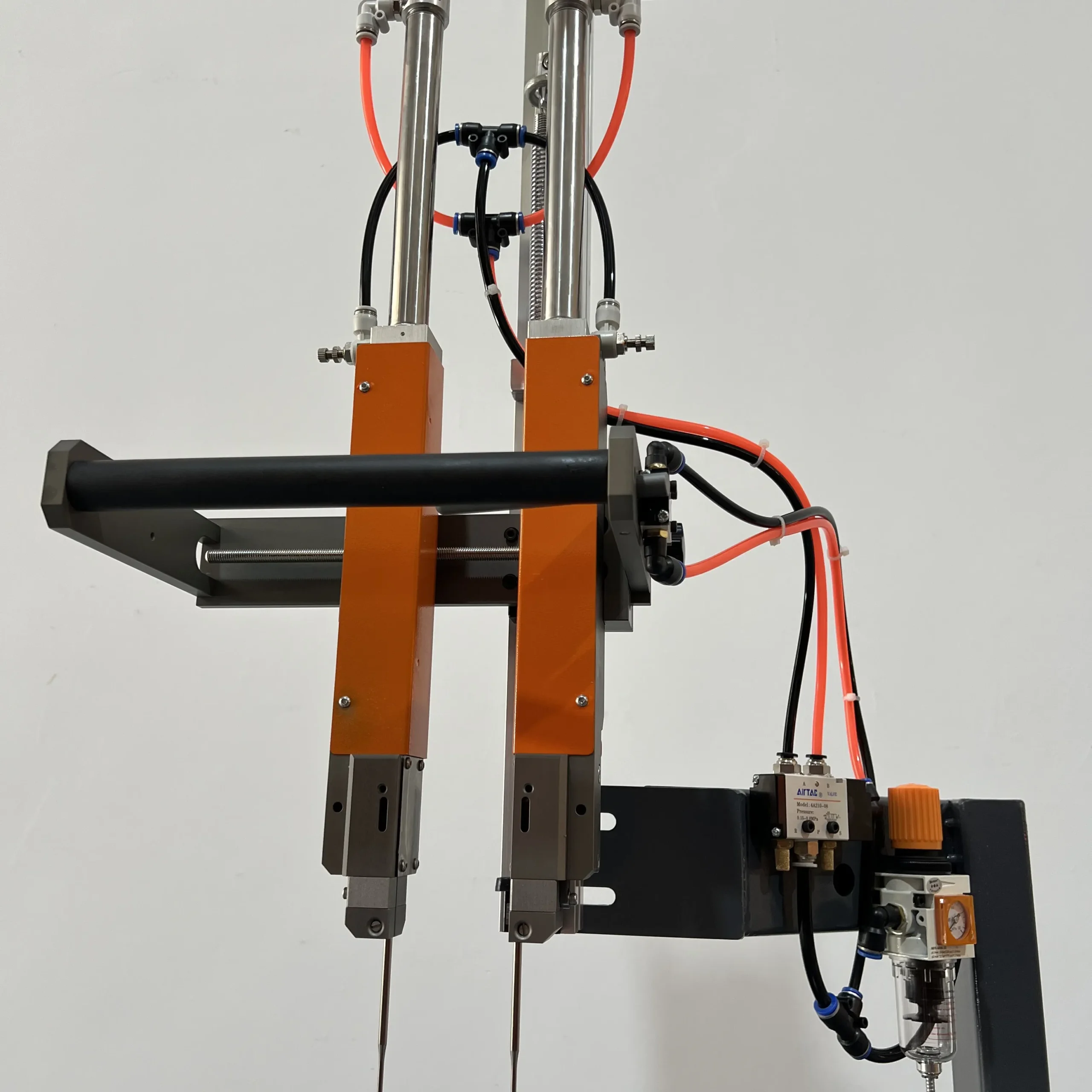
Adjustable Needle Distance: 10mm to 188mm (Fully Customizable Span)
Cycle Speed: Approximately 0.5 seconds per binding cycle
Chassis Dimensions & Weight: 60 x 48 x 100 cm | Net Weight: 15kg
Material Construction: Grade 304 Stainless Steel Shell + Integrated Aluminum Alloy Frame
Needle Options Available: 80mm and 120mm Industrial-Grade Heavy-Duty Needles
2. Breaking Through Maintenance Bottlenecks: Bladeless Fastening Technology
Traditional elastic stapling machines rely on miniature internal mechanical blades to slice each plastic staple from the continuous filament roll. In high-volume factories, these blades dull rapidly when cutting thousands of fasteners a day, leading to frayed edges, frequent downtime, and rising replacement costs.
Modern high-tier pneumatic bundling machines solve this via Bladeless Fastening Technology.
How It Works: Instead of a traditional exposed utility blade, the system utilizes a high-precision, low-maintenance shearing die integrated directly within the heavy-duty needle housing block.
The Operational Benefit: This significantly lowers maintenance overhead, eliminates the hazard of exposed cutting edges for workshop operators, and ensures an ultra-clean, burr-free clip every 0.5 seconds.

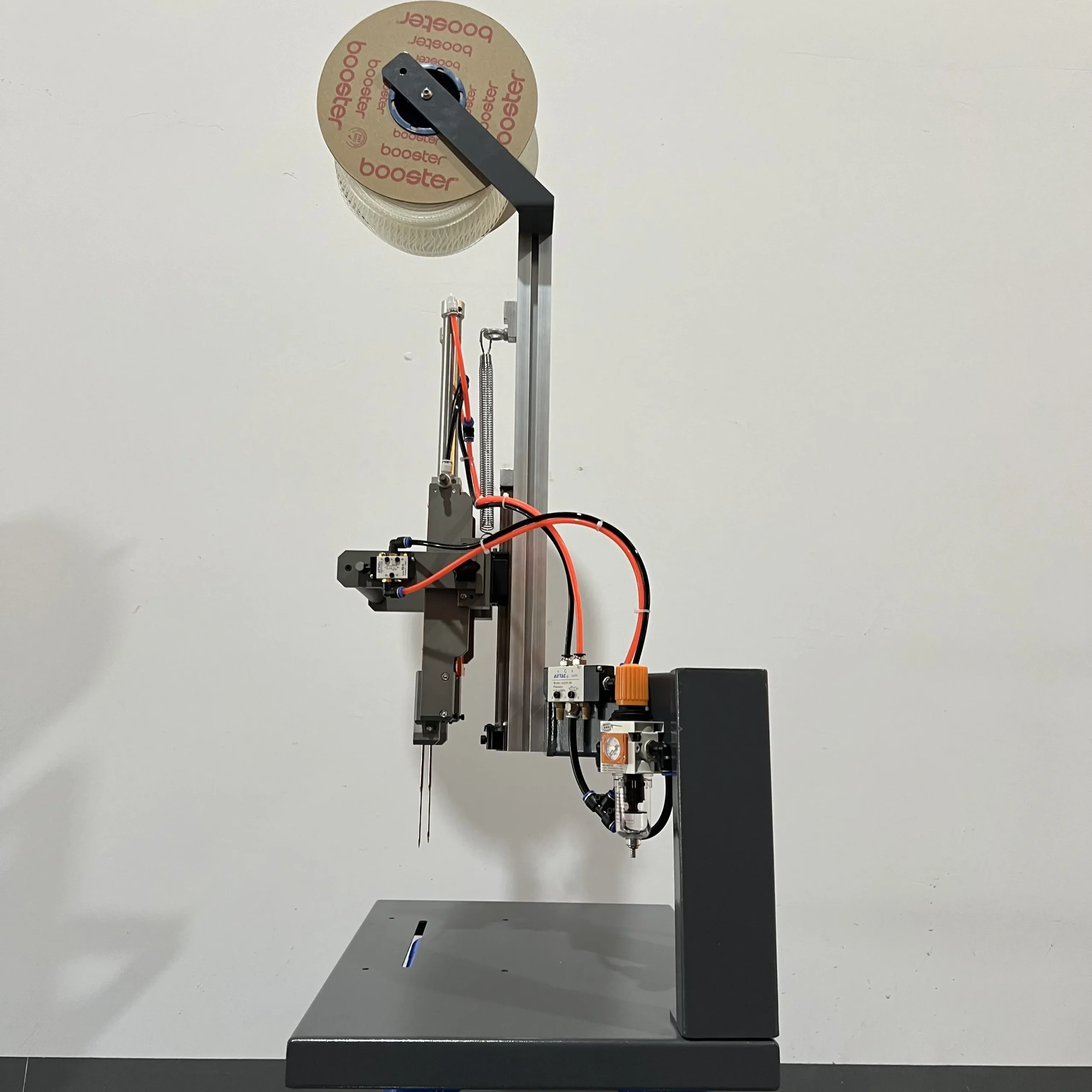
Elastic Staple Pins Sewing Machine
3. The Power of Customization: Variable Needle Spacing (10mm – 188mm)
A major limitation of early-generation taggers was their fixed spacing. If you changed product sizes, you had to purchase entirely new machinery.
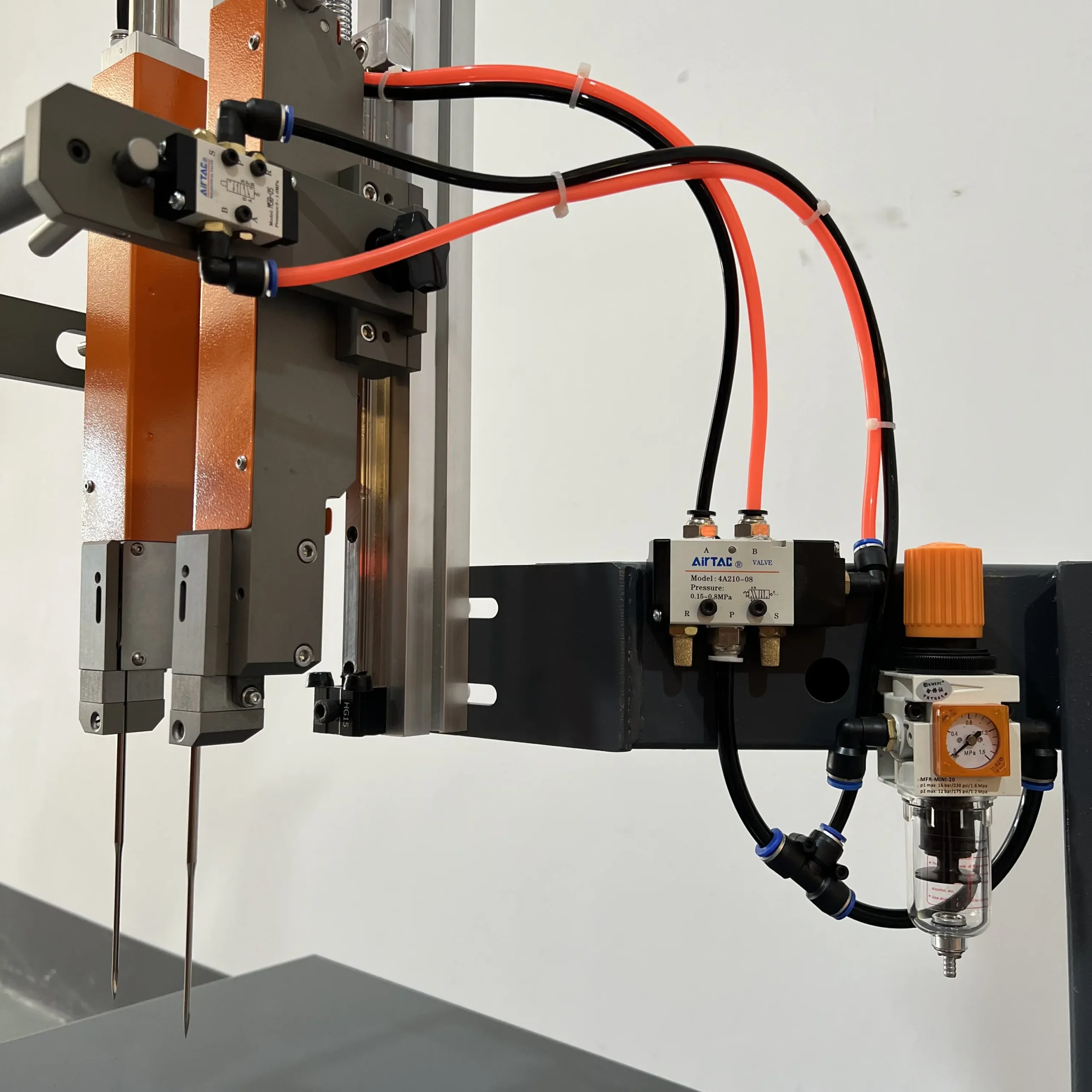
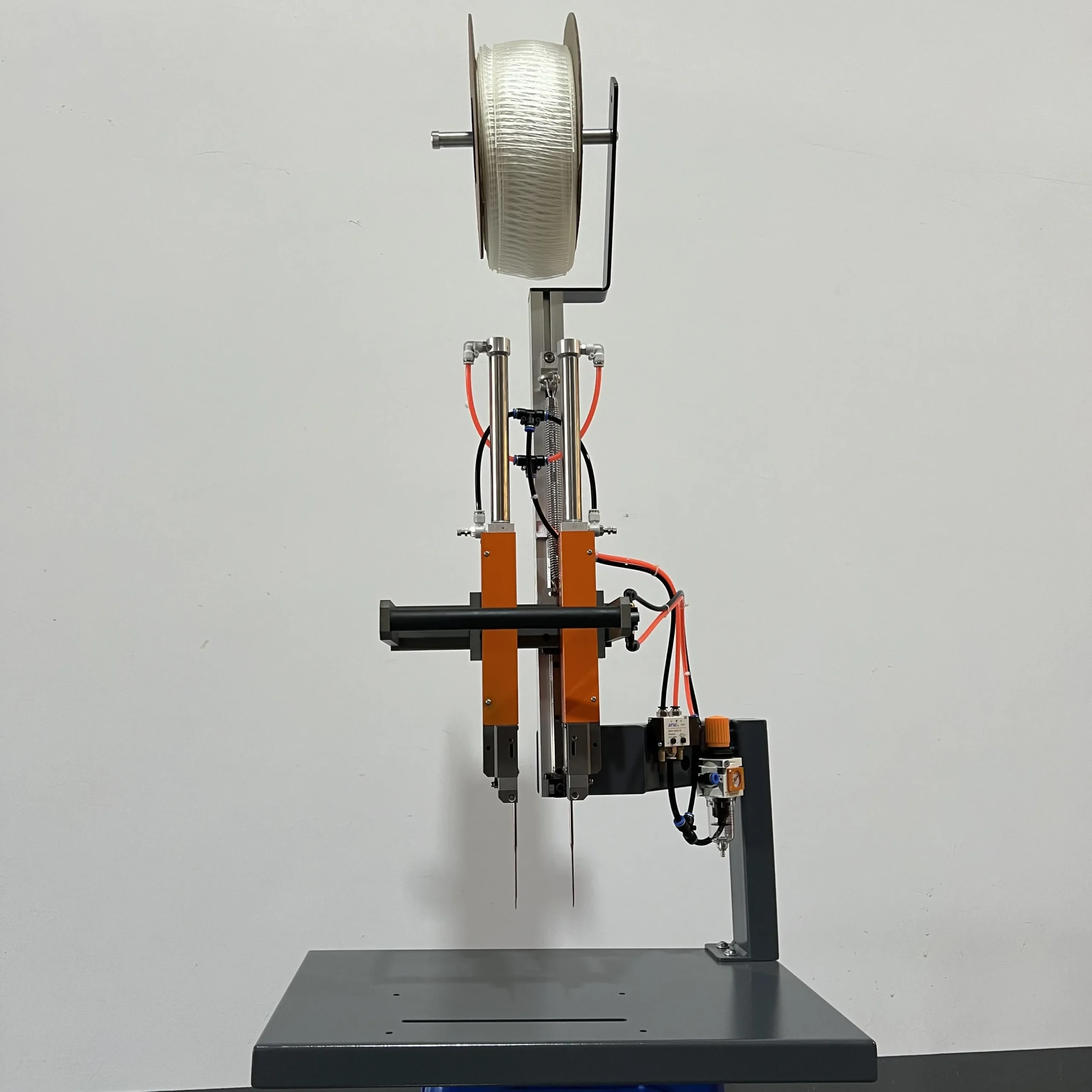
The dual-cylinder configuration featured in contemporary aluminum-alloy frames offers a fully adjustable needle span ranging from 10mm to 188mm. By loosening the lock bolts on the linear guide rail, setup technicians can slide the two orange cylinder sub-assemblies closer together or further apart. This single mechanical asset allows a factory to pack tiny hair accessories in the morning and wide agricultural tools in the afternoon on the exact same workstation.
4. Multi-Sector Applications: From Hardware to Consumer Goods
Because the grade 304 stainless steel exterior resists corrosion and the heavy-duty work platform tolerates high impacts, this equipment has become the go-to alternative for back-card skin packaging across several distinct sectors:
Hardware & Agricultural Tools: Securely locking heavy wrenches, pliers, screwdrivers, or trowels directly onto thick corrugated cardboard backings without using expensive vacuum plastic shrink wrap.
Toys & Retail Card Displays: Binding action figures, toy vehicles, and novelty items tightly to their display cards, ensuring high retail shelf visibility and anti-theft security.
Kitchenware & Tableware: Bundling stainless steel spoons, knives, forks, or silicone spatulas into neat sets. The non-toxic plastic filament replaces sticky adhesive tapes that leave hard-to-clean chemical residues on food-contact surfaces.
Silicone & Rubber Products: Providing firm, elastic compression on flexible silicone components and hair accessories without puncturing or tearing the core product material.
Elastic staple machine double head
5. Frequently Asked Questions (FAQ)
Q1: What is the main advantage of “Bladeless Fastening Technology” over traditional systems?
A: Traditional machines use a separate, exposed mechanical blade to cut the plastic filament. These blades dull quickly, require frequent replacement, and cause jagged edges or jams when worn. Bladeless Fastening Technology utilizes an internal, high-precision shearing die integrated directly into the needle block assembly. This design drastically reduces maintenance costs, completely eliminates exposed sharp edges for operator safety, and ensures clean, burr-free cuts over millions of cycles.
Q2: Can this machine run on a standard home/office power supply?
A: This specific dual-cylinder bundling machine is 100% pneumatic-driven, meaning it operates entirely on compressed air and requires zero electricity. As long as your workshop is equipped with an air compressor capable of delivering a stable pressure of 0.4 to 0.5 MPa (4 to 5 bar), you can deploy this machine anywhere without worrying about electrical compatibility or power bills.
Q3: How do I adjust the distance between the two staples?
A: The machine features a highly flexible linear guide rail with an adjustable span ranging from 10mm to 188mm. To adjust the distance, simply loosen the locking bolts on the aluminum alloy frame, slide the two orange cylinder assemblies to your desired width using the built-in measurement guide, and retighten the bolts. This allows a single machine to handle vastly different product sizes on the same line.
Q4: What is the difference between the 80mm and 120mm needle options?
A: The needle length dictates the maximum thickness of the product package you can bind:
80mm Needles: Ideal for standard, flatter items such as clothing labels, socks, thin silicone mats, and light hand tools.
120mm Needles: Engineered for high-clearance, heavy-duty applications, such as thick agricultural tools, large stuffed toys, or stacked kitchenware sets.
Q5: Will the piercing needles damage delicate items like silicone kitchenware or fine textiles?
A: No, provided you use the correct industrial-grade hollow needles. The needles are made of high-purity, polished 304 stainless steel with a smooth, rounded tip architecture. They are designed to part the fibers of textiles or compress resilient materials like silicone rather than tearing them, ensuring the product remains completely undamaged after the staple is removed.
Q6: Why is my machine cycling, but only deploying one staple instead of two?
A: If one side fails to fasten, check the following three factors:
Material Feed: Ensure the plastic filament roll is feeding smoothly into the rear slot of both cylinders without twisting.
Pneumatic Symmetry: Check the Y-splitter air hose connecting the main valve to the cylinders. If one hose is bent or leaking, that cylinder will lack the pressure required to shear the filament.
Debris Jam: Disconnect the air supply and use a fine steel clearing wire to ensure no residual plastic fragments are lodged inside the faulty needle shaft.
Elastic Staple Fasteners Machine
Conclusion: Future-Proofing Your Packaging Workshop
Transitioning to a dual-cylinder, blade-free pneumatic bundling machine allows export-driven manufacturing plants to achieve stable, high-speed automated fastening. With an energy-efficient pneumatic footprint requiring zero electricity, a compact 15kg desktop profile, and a highly versatile 10mm to 188mm adjustable track, this machinery addresses the core industrial requirements of modern fulfillment centers: high speed, zero chemical adhesives, and minimal maintenance overhead.